


- Search Intent Versus Exploratory Intent
- Two in One? The Example of YouTube
- How to Think your Content Strategy
- Repurposing Search Content on Social Media and Vice-versa
When I was starting my career in content, I used to publish all videos produced for Facebook on YouTube, TikTok, and any other social media platform I could think of. Yes, content production is expensive, and even more adapting it for every single platform. There was (or so I thought) a much simpler solution: Editing all videos in 16:9, to later quickly re-export them in the different formats depending on what each platform required. And that was it. Was it?
Long story short: The videos never performed great on YouTube. Sometimes there were hits, but they were too isolated despite constantly uploading content. The majority of them only received a hundred of views, and it seemed like I was never going to be able to amass a good amount of subscribers.
On the other side, Facebook was something else. Videos quickly went viral, with thousands of comments, likes, and all kinds of interactions that feed the algorithm to distribute them more and more. Those Facebook successes made me evade the fact of the evident failure on the YouTube channels. I even went to the extent of incresing the publishing frequency to levels never seen before. But it was all for nothing. The problem wasn’t connected to the production output.
Either because of a lack of budget or knowledge, it’s easy to fall into the temptation of replicating what I was doing with Facebook videos on YouTube. However, an adequate (and successful) content strategy can’t ignore a fundamental question: What are the audience’s intentions and expectations regarding the content they are hoping to consume in different distribution channels?
Search Intent Versus Exploratory Intent
From the audience’s point of view, there are several ways of consuming content. Here I’ll talk about two: the search intent, crucial for SEO, and the more spontaneous, exploratory intent, common to social media.
Lentils recipe for dinner? Best electric toothbrush? How to clean drainage? All examples of search intent, to find answers or concrete information about a specific topic. A dog that’s about to perform a trick? Emotional family reunion? Fun fact about why ants walk in a line? Exploratory intent, generally connected to entertainment purposes.
Let’s check another example: It’s not the same going to the movies, buying popcorn, relaxing in the theater seat and swallowing up half an hour of advertisement, trailers, and then twenty minutes of a slow-paced movie until something happens; that opening TikTok and scrolling without mercy through hundreds of videos.
When prompting a search, the audience has not only decided to navigate on a specific platform, but they also have the expectations regarding what they are going to find. On the contrary, during an exploration, even if there is an intention of consuming concent in a general way, there isn’t a specific intentionality about what exactly will be found.
From this perspective, there are two different types of content and distribution channels: Content created for search engines and content created for social media. The latter works with an audience that consumes what the algorithm deems relevant according to the information and behavior gathered. There is, however, one big exception.
Two in One? The Example of YouTube
The “strategy” that I described in the beginning only actually worked when YouTube, under pressure after the relentless success of TikTok, launched YouTube Shorts. That’s how the main video search engine transformed itself into a platform that now could answer to both intents and that, in consequence, started to demand two different content strategies.
Now the videos, originally created for Facebook, succeeded on Shorts. The reason was evident: Shorts, just like Reels, TikTok and Snapchat, do not answer (predominantly) to a search intent.
The key lies in understanding the audience’s expectations, that initial decision of the user that will guide if they navigate on one platform or another, hoping to find a specific type of content. The following table shows a general representation of how different distribution channels for content respond to one or another purpose:
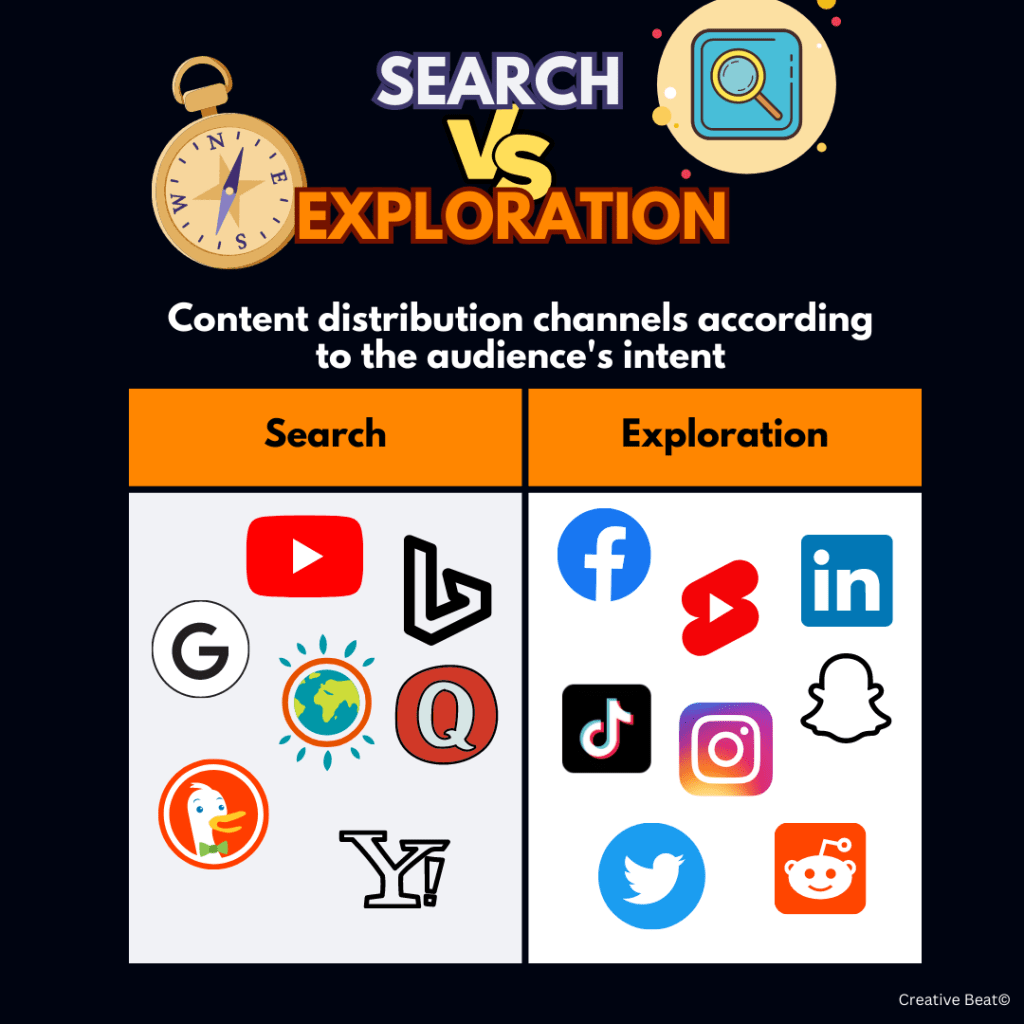
Search Intent Channels (Search Engines):
- YouTube (foe videos)
- Bing
- Ecosia
- Yahoo!
- Quora
- Duckduckgo
- Etc.
Exploration Intent Channels (Social Media):
- YouTube Shorts
- TikTok
- Snapchat
- Etc.
Creative teams and content strategists have to consider not only where to distribute the content, but also how to structure it (internally) and how to angle them correctly according this intent. Forgetting that and post the same content on a multitude of platforms will only be effective if those platforms respond to the same intent.
How to Think your Content Strategy
Planning a content strategy is entertaining precisely because there are so many factors that play a role in the decision-making process: The type of audience, the goal of the content, the format, the production budget, the publishing frequency, the publishing times, and a long etcetera.
The purpose of the audience is the fingerprint that will determine an array of concrete decisions around the type of content, topics, rhythm, narrative structure, and, of course, on which platforms to post.
Talking about the audience with search intent means opening a Pandora box connected with search engines and SEO. In a different occasion I will delve into these topics and the types of searches that a user does with different purposes. What’s important is to understand that this type of audience has a deliberate purpose, and that the content will only be valuable when this goal is met or a need is satisfied.
And talking about exploratory intent and the content connected to social media is opening another Pandora’s box. It’s also the one I’m most passionate about because it requires mastering storytelling strategies to engage an audience that is not specifically seeking to consume your content. For now, we’ll say that on the majority of social media platforms, users consume content in a spontaneous manner. The factors playing a role are more emotional than rational.
Here is a short list of decisions that you can take depending on which audience intent you have identified for your content:
Search Intent:
- Type of content: primarily informative or educative.
- Content goals: to be actionable, deliver concrete value, satisfy a need.
- Distribution channels: search engines.
- Possible structure and optimizations: related to SEO.
Exploratory Intent:
- Type of content: primarily entertaining, based on interests.
- Content goals: discover, explore, surprise.
- Distribution channels: Social Media.
- Possible structure and optimizations: based on storytelling structures and narrative strategies.
Repurposing Search Content on Social Media and Vice-versa
With all that has been said, I don’t believe it’s impossible to create a strategy where search content can’t be repurposed on Social Media and viceversa. In fact, it’s possible and necessary.
As I mentioned in the beginning, content production is expensive and time-consuming. In this context, repurposing is a widely used strategy to serve relevant content to the audience in different places where they might connect with a brand. When repurposing is done correctly (having in mind to whom, when, what, and where to post), you can keep your channels alive and your audience happy without an enormous budget each time. Repurposing content effectively requires adaptation. Simply adjusting a video’s orientation (vertical or horizontal) won’t suffice.
If I were looking to publish a Reel about this article, I would have to record a video in first person, find an engaging narrative structure, use a different tone, etc. For YouTube, it may be enough to transform the article into a script with a similar tone and add a few animations to follow a voice-over.
There’s no doubt that this article opens up many other discussions around topics like SEO, storytelling, distribution channels, etc. But for now, I would like to end by asking you the question: How do you do deal with content in your different distribution channels? Do you have a strategy in place that considers the audience’s intentions?
 CREATIVE BEAT
Leave a comment